“Welcome To New India”: When Immigration Concern Becomes Racial Scapegoating
A Note On What This Article Is — And Is Not
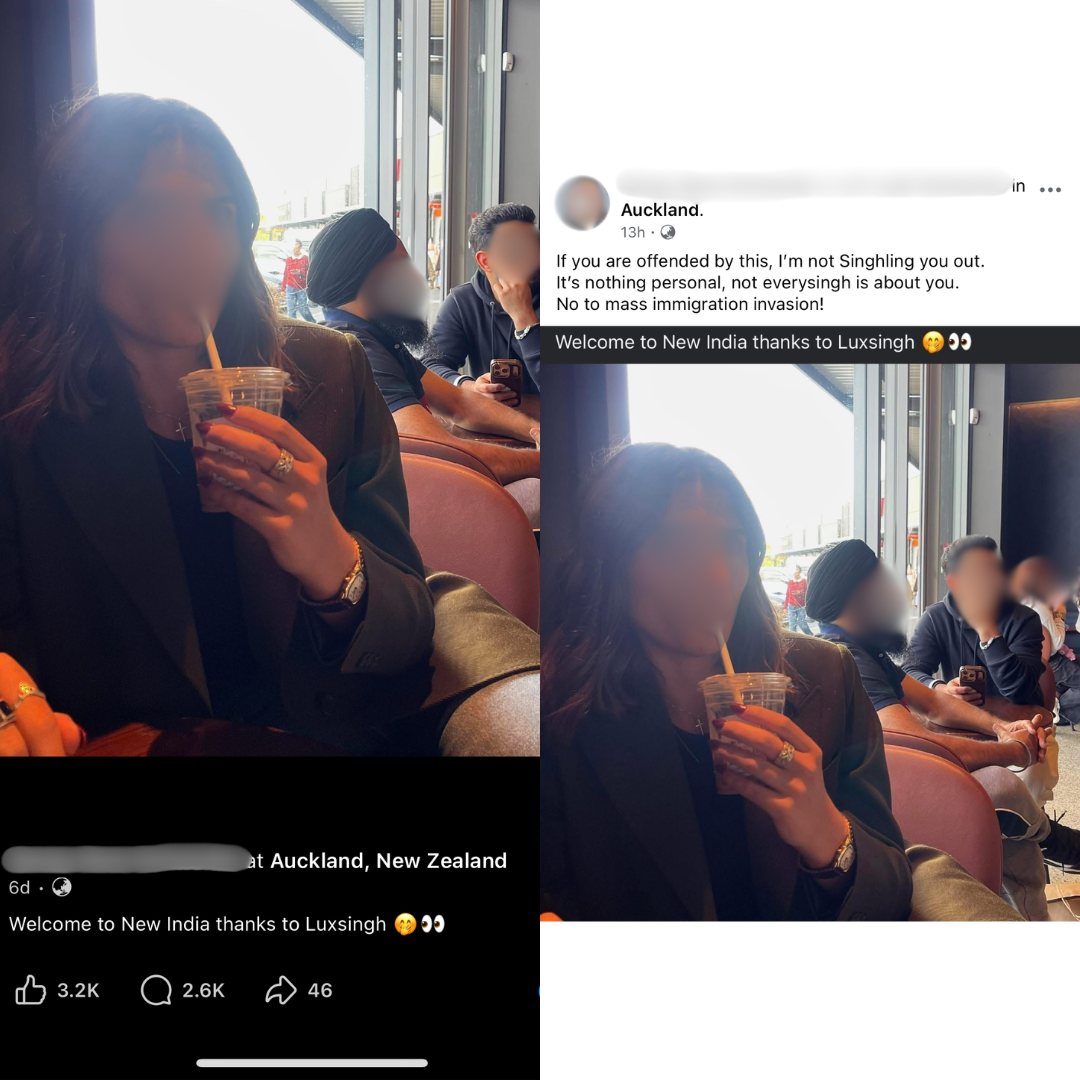
This article is a response to a public Facebook post, the comments that followed it, and the misleading claims being used to defend it. The original post showed two Indian men sitting in an Auckland café with the caption “Welcome to New India thanks to Luxsingh,” followed by a later post using “Singh” wordplay and the phrase “mass immigration invasion.”
This is not an argument that immigration policy is beyond criticism. It is not an argument that New Zealand should avoid serious debate about housing, infrastructure, wages, migrant exploitation, visa settings, public services, population planning, or social cohesion.
Those are legitimate policy issues.
But that is not what this post did.
A serious immigration argument would engage with policy, numbers, labour markets, infrastructure, housing, government planning, or the design of visa categories. This post did something different. It used ordinary Indian people in a public space as visual evidence of national decline.
That distinction matters.
Photographing or using random Indian people in a café as the image of “New India” is not policy analysis. It is a racialised visual argument. It takes people who are simply existing in public and turns them into symbols of invasion, replacement, and cultural loss.
That is not immigration debate. But it is scapegoating.
The Framing Was The Problem
The phrase “Welcome to New India” does not neutrally discuss immigration. It suggests that the visible presence of Indian people means New Zealand is becoming something foreign, excessive, or lost.
That framing is important because it tells the audience where to direct its anxiety. It does not ask people to think about government planning, employer behaviour, housing supply, visa settings, or public infrastructure. It points at Indian bodies and invites people to treat their ordinary presence as proof of a problem.
That is why the defence of “I’m just concerned about mass immigration” does not fully answer the criticism.
A person can oppose high migration settings without using random Indian people as the symbol of what they fear. A person can criticise government policy without turning Sikh names into punchlines. A person can debate the New Zealand–India Free Trade Agreement without treating Indian families, workers, students, or café customers as evidence of “invasion.”
When the object of the post is not a policy document, not a graph, not a government announcement, but people, the issue has shifted.
It is no longer only about immigration policy, but about who is being made to carry public resentment.
What The Comment Section Revealed
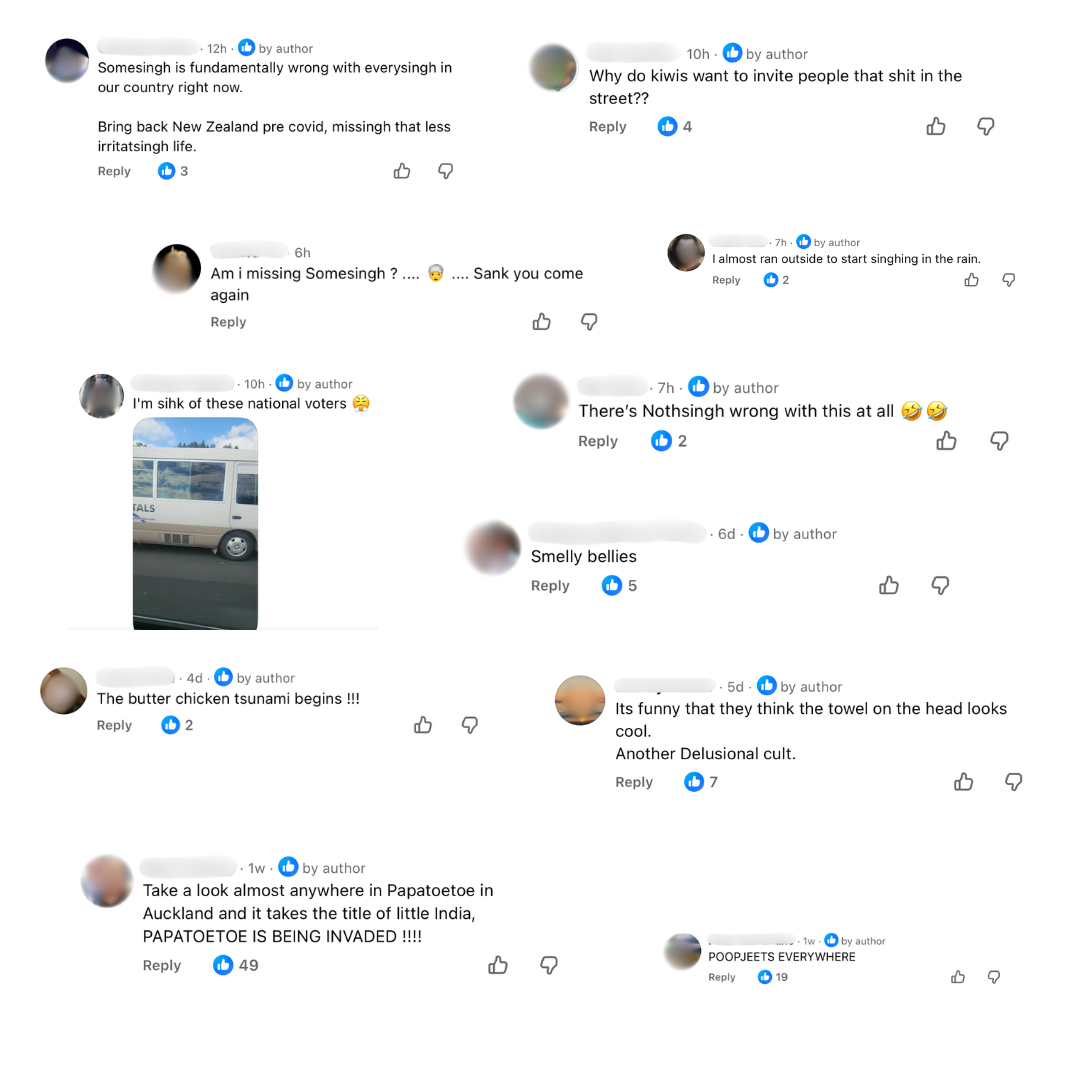
Some defenders will say the post was only a joke or only an opinion. But the comments underneath showed exactly what this kind of framing invites.
Once Indian people were presented as the symbol of “New India,” the discussion did not remain focused on visa settings or government planning. It quickly moved into ethnic-name mockery, racial stereotyping, criminal suspicion, voting panic, and general hostility toward Indian people as a group.
The repeated jokes using “Singh” as a punchline were not harmless wordplay in that context. They were part of a wider pattern where Sikh and Indian identity became the object of ridicule. The issue was not simply that people made jokes. The issue was that the jokes sat underneath a post already framing Indian presence as national decline.
That is how racial scapegoating often works. It begins with a supposedly casual observation. It is defended as humour or common sense. Then the comment section reveals the real permission structure - people feel invited to say what they already think about the group being targeted.
The comments did not misunderstand the post, but rather, they understood the cue.
Immigration Policy Can Be Debated Without Racialising Immigrants
There is a clear difference between criticising immigration policy and racialising immigrants.
A policy critique might argue that New Zealand needs stronger infrastructure planning. It might argue that housing supply has not kept pace with population growth. It might question temporary visa settings, employer accreditation rules, labour exploitation, wage suppression, public transport planning, health service capacity, or the relationship between migration and education demand.
Those arguments can be made seriously.
But “Welcome to New India,” attached to Indian people in a café is not that kind of argument. It does not explain which policy has failed. It does not show what migration number is sustainable. It does not distinguish between citizens, residents, students, workers, visitors, families, or New Zealand-born people of Indian ethnicity. It does not engage with government responsibility or employer behaviour.
It simply makes Indian visibility feel alarming.
That is why the post should be understood as racialised scapegoating rather than serious policy commentary.
New Zealand Has Seen This Pattern Before
New Zealand has a long history of selecting visible minority groups and making them carry wider anxieties about migration, labour, housing, employment, crime, and cultural change.
Pacific peoples know this pattern well. During the Dawn Raids era of the 1970s, Pacific communities were targeted and treated as the face of an “overstayer” problem, even though the issue was more complex than the public narrative suggested. NZ History describes the 1974–76 Dawn Raids as one of the most blatantly racist attacks on Pacific peoples by the New Zealand government.
The comparison is not that a Facebook post is the same as state raids. It is not.
The comparison is about the logic underneath. A visible brown migrant group is selected, exaggerated, and made to carry public anxiety about national change.
The target changes over time. Pacific peoples have been blamed. Asian migrants have been blamed. Muslims have been blamed. Indian migrants are now increasingly used as shorthand for overcrowding, job anxiety, housing pressure, cultural change, and political resentment.
The method stays familiar.
First, identify a visible minority. Then exaggerate their numbers or cultural presence. Then present them as evidence that the country is being lost. Then deny racism by saying the real issue is “immigration,” “assimilation,” “values,” or “just a joke.”
That is why context matters. A single post may look casual, but it participates in a much older pattern.
The Personal Contradiction Matters
There is an obvious contradiction when someone with a family migration story uses another minority group’s presence as evidence of national decline.
That does not mean people from migrant families are not allowed to hold views about immigration policy. They are. Having migrant ancestry does not require anyone to support every immigration setting, every visa category, or every government decision.
But there is a moral difference between debating policy and using a racialised group as the face of decline.
For many ethnic minorities, racism is not abstract. It is being stared at. It is hearing your parents’ accents mocked. It is watching your name turned into a joke. It is being asked where you are “really” from. It is being treated as if your ordinary presence in public requires explanation.
That is why this post landed the way it did.
It treated Indian people as symbols, not as people.
For me, this is personal too. I am of Samoan heritage. My parents moved to New Zealand in the 1990s, and I was born and raised in a diverse West Auckland community where migration was not some abstract political threat. It was family. It was neighbours. It was church communities, school friends, shop owners, workers, parents, children, and ordinary people trying to build lives.
Pacific communities know what it feels like to be turned into the face of an immigration problem. That history should make us more careful, not less, when another minority group is being framed the same way.
The Assimilation Argument Is Selective
One of the most common defences in these conversations is that the issue is not race, but assimilation.
That argument needs to be tested.
Many communities in New Zealand maintain language, religion, food, clothing, family structures, cultural institutions, churches, temples, mosques, community centres, media, festivals, and social networks. That is not automatically a failure to belong. It is often how communities survive, adapt, and contribute.
Pacific communities have done this for generations. I am Samoan. I speak Samoan fluently. That did not come from assimilating into invisibility. Pacific communities have retained language, faith, family structures, traditional dress, music, food, church life, early childhood centres, and cultural spaces across generations.
We did not become acceptable by disappearing.
New Zealand also recognises a special migration relationship with Pacific countries. Immigration New Zealand says the Samoan Quota allows up to 1,100 Samoan citizens to gain New Zealand residence each year, while the Pacific Access Category provides annual residence places for citizens of Fiji, Tonga, Kiribati, and Tuvalu.
So if the argument is genuinely that migrant communities should not maintain visible cultural life, then that argument would have to be applied consistently. It would have to object to all other languages, churches, clothing, early childhood centres, and community spaces too.
But that is not usually what happens.
Instead, Indian visibility is treated as uniquely alarming.
That inconsistency suggests the issue is not assimilation in any principled sense. It is selective discomfort with a particular minority group.
English-Language Panic Needs Context
Another claim that often appears in these discussions is that migrants arrive with family members who supposedly cannot speak English and will not assimilate.
Again, that is not careful policy analysis. It is suspicion generalised across whole communities.
New Zealand immigration settings already include English-language requirements in many residence pathways. Immigration New Zealand says skilled residence principal applicants must show English ability, and partners or dependent children aged 16 or older must either show they can speak and understand English or, in some cases, pay for English-language lessons in New Zealand.
That does not mean language barriers never exist. They do. It does not mean settlement support is perfect. It is not. It does not mean every migrant has the same English ability. They do not.
But anecdotes about one interaction with one worker or one family are not evidence that whole communities are refusing to integrate.
They are anecdotes.
A serious discussion would ask what settlement support exists, whether English-language education is accessible, how employers communicate with workers, whether migrants are being exploited, and how public services support multilingual communities.
A racialised discussion simply points at Indian or Chinese workers and treats their accents, language ability, or cultural difference as proof that they do not belong.
Voting Panic Is Being Misrepresented
The claim that migrants can arrive and vote “12 months after getting off the plane” is also misleading without context.
New Zealand does allow some non-citizen residents to vote, but not every person who arrives on a plane is eligible. Electoral information states that a person must be 18 or older, a New Zealand citizen or permanent resident, and must have lived in New Zealand continuously for one year or more. People on temporary work or study visas are not automatically given the right to vote simply because they are present in the country.
People can debate whether New Zealand’s resident voting rules should remain as they are. That is a legitimate constitutional and democratic question.
But using Indian people in public as evidence of a voting takeover is not a serious electoral-law argument. It is demographic fearmongering.
It takes a real feature of New Zealand’s voting system and presents it in the most inflammatory way possible, while implying that Indian migrants are a political threat.
Surname Data Is Being Misused
One of the most circulated claims in these conversations is that Singh, Kaur, and Patel appearing among common registered family names for newborns proves that New Zealand is becoming “New India.”
This is a perfect example of how a real statistic can be used in a misleading way.
The Beehive release on 2024 registered family names does not say Singh and Kaur are the most common first names. It refers to family names registered for newborns. In 2024, Singh was the most common registered family name, with over 680 babies. Kaur was second, with 630. Smith was third, with 300. The release also says that in the North Island, Singh, Kaur, and Patel were the most common registered family names, while in the South Island, Kaur, Singh, and Smith took the top spots.
That sounds dramatic only when surname concentration is misunderstood.
The Department of Internal Affairs registered 59,199 births in 2024. Against that total, just over 680 babies registered with the family name Singh is around 1.1 percent of births. Singh and Kaur together are around 2.2 percent.
That is not evidence of a population majority.
It is not evidence of demographic takeover.
It is evidence that some surnames are highly concentrated within particular communities.
Singh and Kaur are widely used Sikh naming markers and are often registered as family names. The Beehive release itself notes that Singh is traditionally used by Sikh men and has become a common family name among the global Indian diaspora. Patel is also a common Gujarati/Indian surname, which means it can cluster strongly in surname data.
Meanwhile, the rest of New Zealand’s births are spread across thousands of different names from many communities. That is why an individual surname can rank first while still making up only a small percentage of total births.
The same logic applies to first names. In 2024, Noah was the top boys’ first name with 250 babies, and Isla was the top girls’ first name with 190. The same release says there were 59,199 births and 19,404 unique names registered that year. Nobody would claim New Zealand is being taken over by Noahs or Islas.
So when surname rankings are used as proof of “New India,” the statistic is not educating the public. It is being stripped of context to provoke racial anxiety.
Indian New Zealanders Are Visible. That Does Not Make Them An Invasion.
Indian New Zealanders are part of New Zealand.
They are workers, students, parents, business owners, neighbours, classmates, colleagues, voters, taxpayers, citizens, residents, renters, homeowners, volunteers, friends, and family members.
The 2023 Census recorded 292,092 people identifying as Indian, or about 5.8 percent of New Zealand’s population. The wider Asian ethnic grouping was 861,576 people, or around 17.3 percent.
That is diversity.
It is not replacement.
A group can be growing, visible, and still nowhere near a majority. The fact that Indian New Zealanders are present in cafés, workplaces, universities, suburbs, shops, building sites, public services, and community life is not evidence of invasion. It is evidence that they are part of the country.
The language of “invasion” is not accidental. It turns ordinary people into a threat. It removes individuality. It makes presence itself seem suspicious.
That is why the original post was not harmless. The two men in the café were not treated as people. They were treated as props in someone else’s political performance.
The New Zealand–India Free Trade Agreement Does Not Justify Racial Panic
Some defenders may try to connect this rhetoric to the recent New Zealand–India Free Trade Agreement.
People can debate trade agreements. They can debate whether temporary movement provisions are appropriate. They can question labour safeguards, infrastructure planning, employer compliance, housing pressure, and government capacity.
But the existence of a trade agreement does not justify using Indian people in public as visual evidence of “invasion.”
MFAT’s National Interest Analysis says the New Zealand–India FTA’s temporary movement annex applies to temporary entry for specific service or business purposes and does not apply to citizenship, permanent residence, or permanent employment. It also says New Zealand has committed to the equivalent of up to 1,667 temporary employment entry visas per year, or 5,000 at any one time, subject to conditions such as education and experience requirements.
The same document says applicants must satisfy conditions and criteria, including acceptable English, a New Zealand employment offer with an accredited employer, suitable qualifications, and relevant work experience where required.
Those details matter because they show why the phrase “invasion” is not analysis.
A trade agreement is a policy document.
Random Indian men sitting in a café are not.
“They Are Taking Kiwi Jobs” Needs Evidence
Another repeated claim is that Indians, or migrants more generally, are taking Kiwi jobs.
That claim is politically powerful because it gives people a simple target for complicated economic problems. But simple does not mean accurate.
New Zealand has real issues with wages, insecure work, housing, infrastructure, employer exploitation, underinvestment, and uneven regional pressure. Those issues deserve serious attention.
But blaming Indian people as a group is not analysis.
MBIE’s response to the Productivity Commission’s immigration report says that, on average, immigration does not drive down wages or replace local workers, and has had a small and mostly positive effect on wages and employment for New Zealand-born workers over the previous 20 years.
That does not mean every immigration setting is perfect. It does not mean every sector is unaffected. It does not mean migrant exploitation is not real. It does not mean government planning cannot be criticised.
But it does mean sweeping claims about Indians “taking jobs” need evidence.
If employers are underpaying workers, blame the employers. If wages are low, look at labour law, bargaining power, enforcement, and business models. If housing is unaffordable, look at supply, speculation, planning, infrastructure, and policy failure. If migrants are being exploited, strengthen protections and punish exploitative employers.
Do not point at Indian people as though their existence explains every economic anxiety in the country.
That is how racial scapegoating works: complicated policy failures are reduced to a visible minority group.
“It Was Just Humour” Is Not A Defence
The follow-up post attempted to turn criticism into a joke through “Singh” wordplay.
But racialised humour has always worked this way. The joke lands by making a group the punchline, and then the target is accused of being too sensitive for noticing.
The comments made that clearer. People were not laughing at visa policy. They were laughing at Sikh names. They were treating Indian identity itself as the punchline.
That is not harmless in this context.
Humour can be political. Humour can challenge power. But punching down at ordinary migrant communities while pretending it is just banter is not brave or clever. It relies on an audience already willing to see Indian people as excessive, foreign, or out of place.
When the joke depends on turning Sikh names into a punchline while using Indian people as evidence of national decline, the problem is not that people missed the humour.
The problem is that they understood it.
“Sensible Xenophobia” Gives The Game Away
One of the most revealing comments defended “sensible” levels of xenophobia and described prejudice as “pattern recognition.”
That sentence exposes the problem.
Xenophobia is not a neutral policy position. It is fear or hostility toward foreigners or people perceived as foreign. Calling it sensible does not make it evidence-based. It only makes prejudice sound more respectable.
“Pattern recognition” is also one of the easiest ways to launder stereotypes. People notice a few examples, ignore counterexamples, generalise about an entire group, and then call it realism.
That is bias looking for confirmation.
A serious immigration debate does not need xenophobia. It needs evidence, policy literacy, historical memory, and honesty about trade-offs. It needs attention to housing, wages, infrastructure, labour standards, exploitation, education, health, transport, and democratic planning.
The moment people start defending xenophobia as sensible, they are no longer simply discussing immigration policy. They are defending suspicion toward people because of where they are from or what group they appear to belong to.
The Issue Is Accuracy, Not Offence
This is not just about hurt feelings.
It is about accuracy.
It is false to imply that surname rankings prove Indians are becoming a population majority. It is false to present Singh and Kaur surname concentration as evidence of demographic takeover. It is false to photograph ordinary Indian people and turn their presence into proof of invasion. It is false to imply that Indian visibility in cafés, malls, suburbs, workplaces, schools, or universities proves national decline.
It is also dishonest to use racialised imagery first, then retreat into “mass immigration” language once challenged.
If the concern is immigration policy, then discuss policy. Discuss numbers honestly. Discuss government settings. Discuss labour exploitation. Discuss housing, infrastructure, healthcare, transport, education, and planning.
But do not use Indian people sitting in a café as props for racial panic.
It is not patriotism.
It is not humour.
It is scapegoating dressed up as commentary.
A Final Note
If the original poster, or anyone defending that post, wants to argue that Indian people are invading New Zealand, taking Kiwi jobs, refusing to assimilate, voting in dangerous numbers, changing the country in some uniquely harmful way, or proving national decline simply by being visible in public, then that argument needs evidence.
Not screenshots.
Not jokes.
Not cherry-picked surname rankings without context.
Not anecdotes about one conversation with one worker.
Not personal discomfort dressed up as political concern.
Actual evidence.
Because personal feelings toward a particular group are not data. Discomfort at seeing Indian people in cafés, suburbs, workplaces, universities, or public life is not proof of an invasion. It is simply discomfort.
If a claim cannot survive contact with basic statistics, historical context, and honest scrutiny, then maybe the issue was never immigration policy.
Maybe it was prejudice.